Skiing’s environmental argument often focuses on lifts, snowmaking and mountain buildings, yet La Plagne identifies the journey to the resort as its largest obstacle. Cars and coaches crowd the valleys on weekends, carrying a carbon cost before anyone clips into a binding. A revived sleeper service offers a different opening: board a repurposed carriage in Paris at night, arrive at Aime-La-Plagne beneath snow and continue uphill by transfer. The destination extends that logic through secondhand equipment, adaptive skiing, free seasonal shuttles and protected terrain accessible only on snowshoes. None of these measures makes an Alpine holiday impact-free, but together they turn sustainability from a label into a chain of practical travel decisions.
Nine Hours Between Rain and Snow
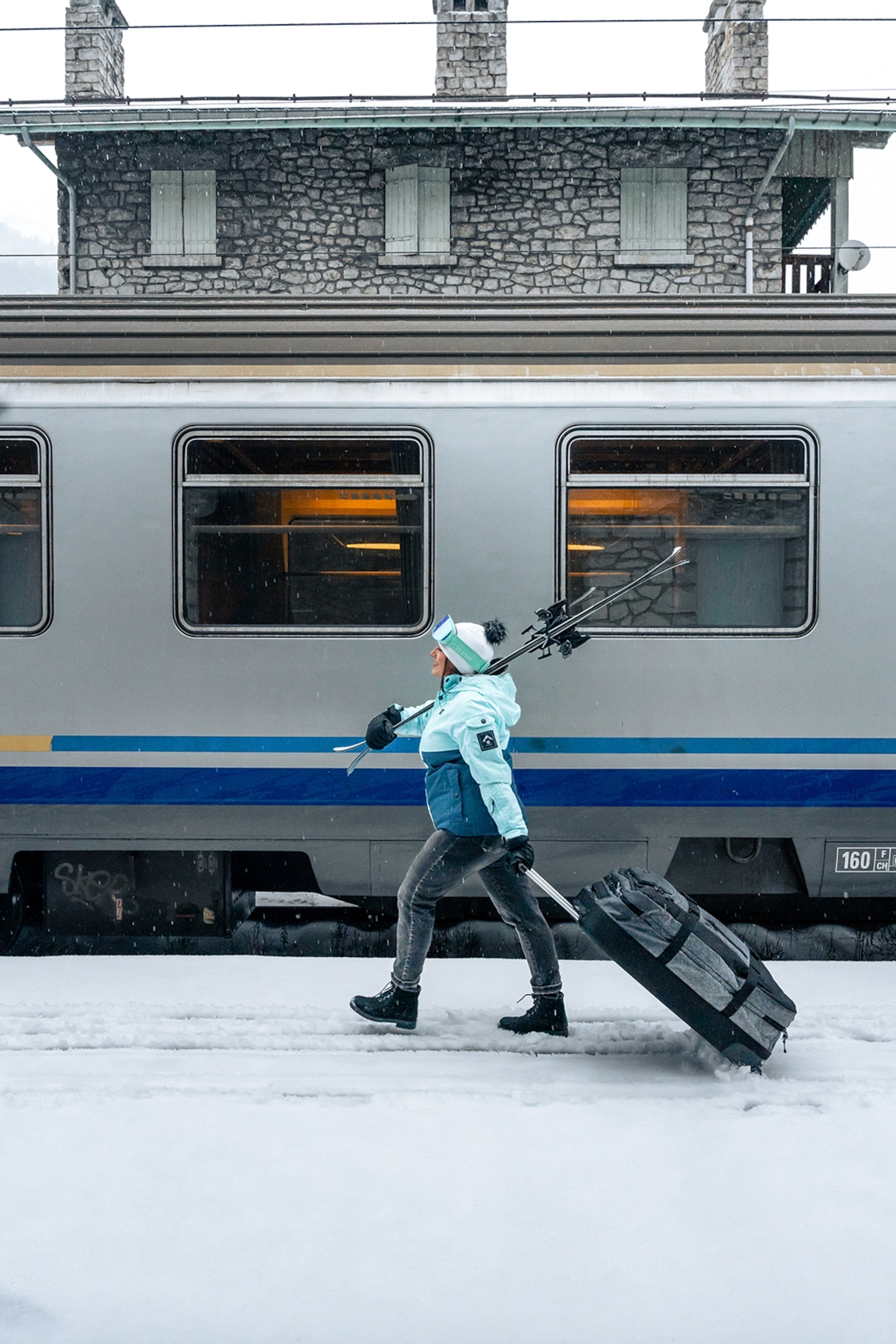
Gare de Lyon on a wet January night offers little preview of a bright Alpine morning. The clue sits on the carriages, where the names Les Arcs, La Plagne, Tignes, Méribel and Val d’Isère recall decades of winter travel. Pegasus Trains restored older rolling stock for a sleeper service chartered by Travelski during the 2025–26 season—the first overnight train to the Alps in nine years.
The six-person couchettes are basic, and the ride can be noisy. Hard berths, rattling carriages and braking interrupt sleep. Arrival supplies the reward: Aime-La-Plagne station under a silver moon, snow thick around frosted windows and a 20-kilometer transfer ahead to the higher resort. The train does not imitate a luxury hotel. Its value lies in replacing a flight or long drive while converting travel time into the night.
Reuse Continues at the Rental Counter
Ski Hut applies the same principle to equipment. Instead of presenting only the latest models, it rents repurposed skis and snowboards at far lower prices. A daily adult package of skis, poles, boots and helmet costs €10, compared with an average local price near €35. Children’s equipment costs €5 rather than roughly €15. Reuse therefore addresses waste and access simultaneously.
La Plagne holds the Flocon Vert, or Green Snowflake, awarded by the nonprofit Mountain Riders to destinations demonstrating sustained environmental commitments. Its work also includes adaptive lessons and equipment for skiers with disabilities. The designation does not remove the resort’s transport problem. Officials identify the heavy weekend flow of vehicles across seven resorts and four traditional villages as a major source of emissions.
Easy Runs, Complicated Mobility
About 80 percent of La Plagne’s 225 kilometers of pistes are blue or red, giving families, beginners and intermediate skiers substantial choice. Plagne Centre sits at 2,000 meters, ringed by broad bowls and lodging close to the snow. From the 2,508-meter Grande Rochette, visitors can choose an easier blue descent or a more demanding red. The wide Mira route provides a forgiving return toward the center.
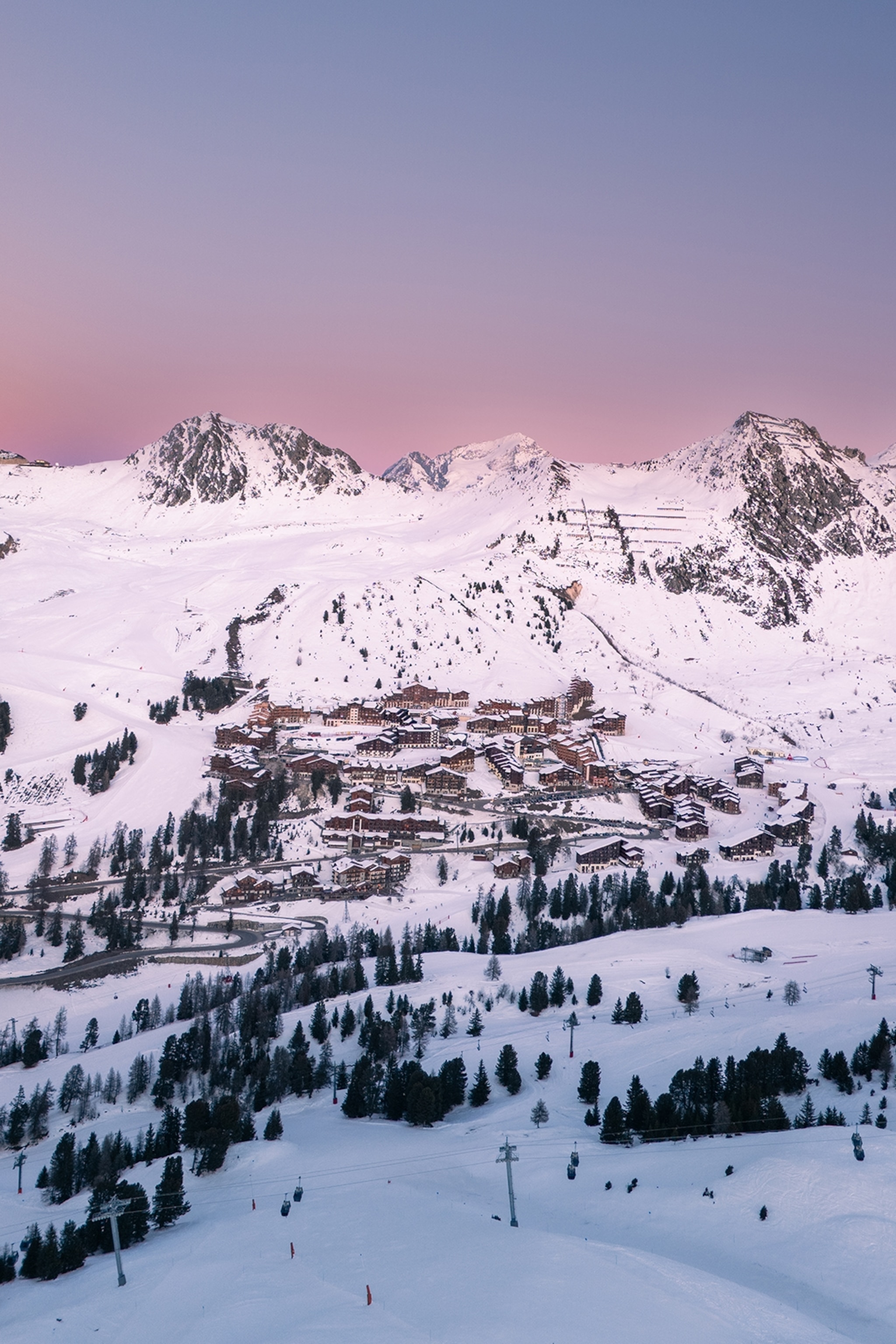
Getting from the valley floor to that connected ski terrain remains the unresolved link. A lift between Aime-La-Plagne station and Plagne Centre is under discussion. Existing free seasonal shuttles already connect villages and base stations, but greater use would be required to meaningfully reduce congestion. The train solves one leg; local circulation determines whether the entire route functions without a car.
Beyond the Family Pistes
La Plagne forms part of Paradiski, with 425 kilometers of linked downhill terrain across seven peaks, more than 180 kilometers of cross-country tracks and 40 kilometers of ski-touring trails. A direct connection reaches Les Arcs. The Roche de Mio gondola, opened in 2025, improved the journey from Plagne Centre and Plagne Bellecôte toward the Live 3,000 summit.
The mountain also carries an Olympic legacy. A 1.5-kilometer bobsleigh track built for the 1992 Winter Games contains 19 bends and will return to competition use when the Games come back to France in 2030. Visitors can choose the Bob Raft, a four-person sled traveling around 50 miles per hour, instead of the faster racing capsule.
Quiet terrain provides the stronger counterweight. La Cembraie, a reserve at 2,000 meters, is reached on snowshoes. Swiss stone pines grow from gypsum-rich limestone, and speckled nutcrackers disperse the forest by hiding seeds and failing to recover some of them. Black grouse shelter in snow structures resembling igloos, so guides avoid unnecessary disturbance.
The destination also shows why an environmental label should be read as a process, not a verdict. The sleeper reduces one journey’s impact but still requires an uphill transfer. Free buses exist, yet private vehicles continue to dominate busy weekends. A proposed valley lift could improve the connection, although construction would bring its own choices. The important point is that transport remains visible as a problem rather than disappearing behind efficient lifts and snowy scenery.
Affordability strengthens the case. Secondhand rentals at €10 for adults and €5 for children make reuse materially attractive, not simply virtuous. Adaptive equipment and lessons broaden who can reach the pistes. Environmental and social access are treated as related questions because both concern how the mountain’s infrastructure is shared.
La Plagne’s sustainability is most convincing when it links these scales. An old carriage is restored, used equipment receives another season, a shuttle replaces a car and a snowshoe trail sets limits around wildlife. The greenest part of the ski day may happen long before the first descent.