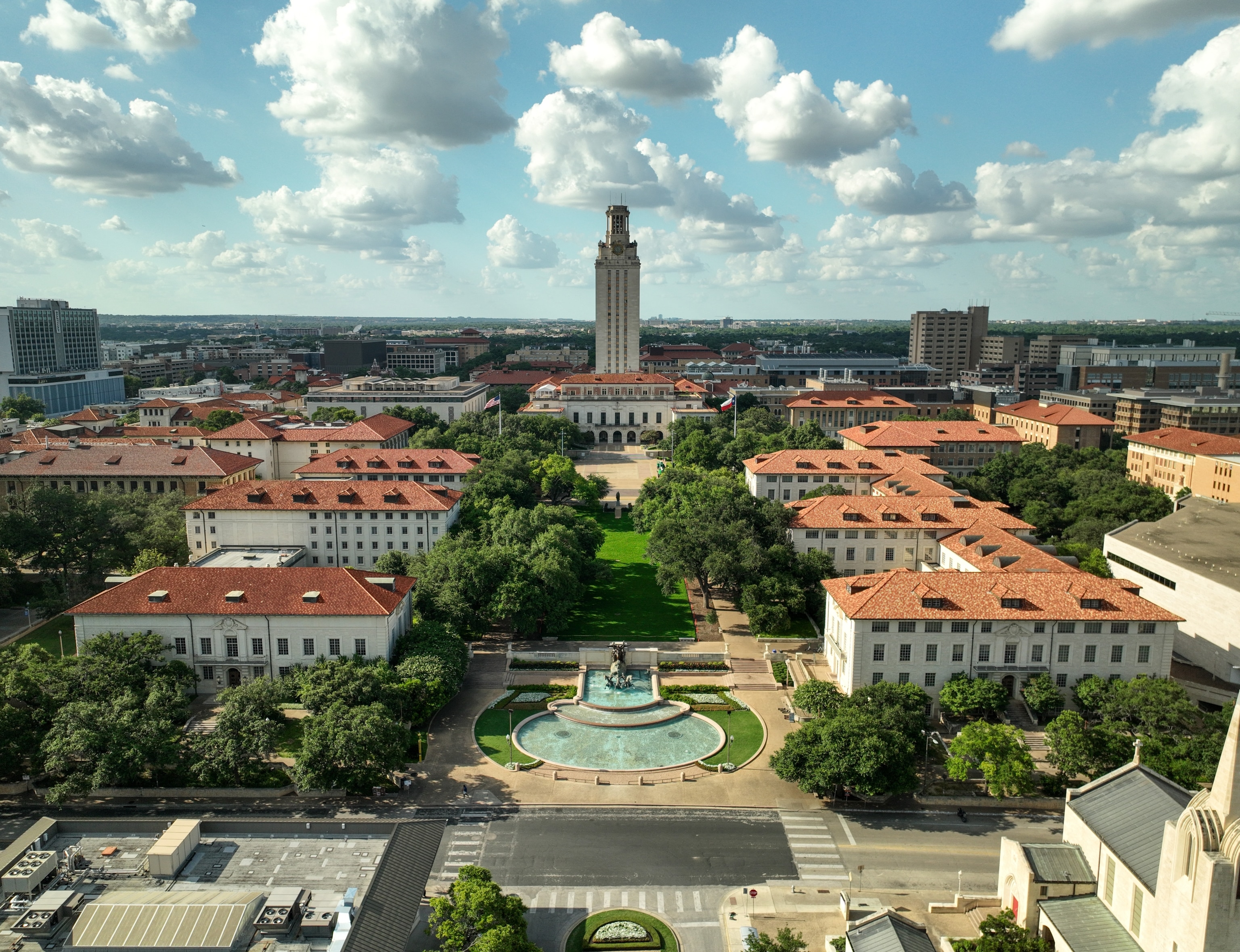
Austin’s skyline now belongs to a million-plus metropolis, crowned by the 1,034-foot Waterline tower that topped out in 2025. At street level, however, the city still moves to institutions and rituals formed when the University of Texas tower and the state capitol defined its horizon. Football turns the campus burnt orange; music spills from clubs linked to generations of performers; cold water at Barton Springs remains a daily counterpoint to Central Texas heat. The city’s transformation from government-and-college town to technology hub is visible everywhere, but growth has not produced a clean break with the past. Austin’s character lives in the overlap between civic ambition, student energy, music history and the outdoors.
When Two Towers Ruled the Horizon
The University of Texas Tower rose to 307 feet in 1937 and remained Austin’s tallest building for 35 years. Nearby, the Texas State Capitol—completed in 1888 in pink granite—carried its own 302-foot dome. Together they gave visual form to the institutions that long defined the city: state government and higher education. Austin had been the capital of Texas since 1845, while the university, founded in 1883, supplied students, faculty and a steady intellectual current.
That earlier Austin was comfortable enough to earn the joking nickname “Velvet Coffin” among some residents in the 1990s: a pleasant place where ambition could soften. The description no longer fits its economy or scale. Technology growth accelerated in the early 2000s, and a skyline of towers followed. When Waterline topped out in 2025 at 1,034 feet, it made the old campus and capitol landmarks appear small without making them irrelevant.
Music Built the Public Myth
Austin’s musical identity predates its modern branding. German American beer gardens hosted choral and folk music in the late 1800s, while Mexican bands, R&B performers and rock acts expanded the sound during the 20th century. Willie Nelson’s arrival in 1972 after an unsuccessful Nashville period helped catalyze a local scene willing to cross genre and social boundaries.
Austin City Limits began taping for PBS two years later. South by Southwest debuted in 1987, then expanded beyond music into film and technology; the Austin City Limits festival followed in 2002. Those large events created an international platform, but the city’s musical continuity still depends on rooms such as the Continental Club, founded in 1955, Broken Spoke, open since 1964, and Hole in the Wall, which has hosted emerging musicians since 1974.
A Capital Best Read Outdoors
Government history is easiest to enter through the Capitol’s free tours, the Bullock State History Museum and the LBJ Presidential Library on the university campus. The Blanton Museum of Art adds another scale of civic experience with a collection of 22,000 works and Ellsworth Kelly’s chapel-like Austin. Yet the city’s public life extends well beyond formal institutions.
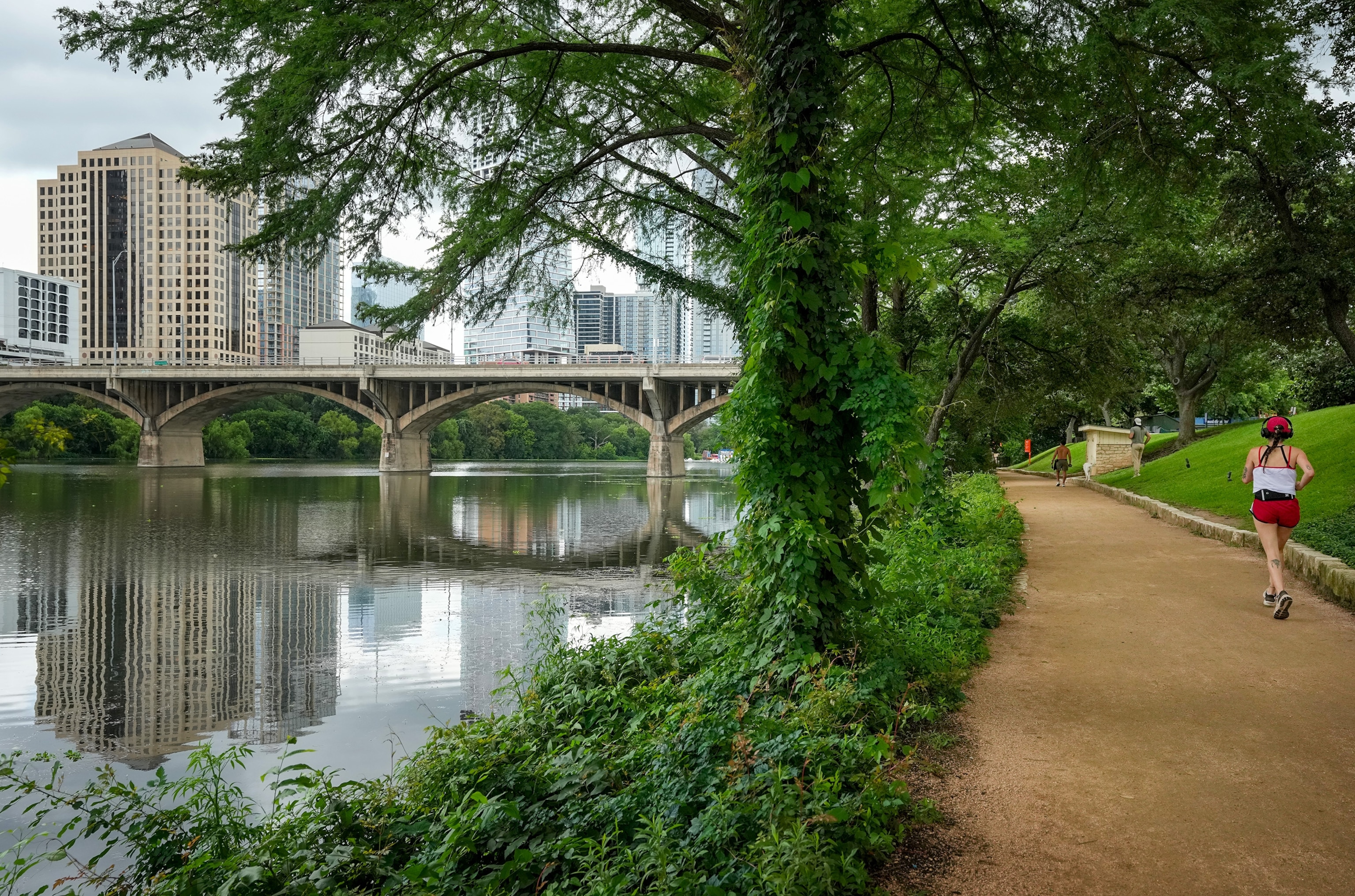
Lady Bird Lake creates a long horizontal clearing beneath the towers, edged by ten miles of paved trails used by runners, cyclists and walkers. Barton Springs Pool stays cold throughout the year, making it a ritual rather than a seasonal novelty. From spring through fall, Mexican free-tailed bats emerge at dusk from beneath Congress Avenue Bridge. These shared outdoor experiences prevent downtown growth from becoming the city’s only story.
Food, Football and the College Calendar
Austin’s food reputation begins with barbecue: brisket, sausage and ribs form the “Texas Trinity,” and Franklin Barbecue’s lines can end in a sellout before lunch. Terry Black’s offers a more spacious old-school setting, while Matt’s El Rancho anchors Tex-Mex with margaritas and its queso-based Bob Armstrong Dip. Uchi represents a different Austin, combining Japanese technique with a Texas setting, and newer cocktail bars sit alongside stubbornly informal campus dives.
The university still reorganizes the entire city on game days. More than 100,000 people can fill Texas Memorial Stadium, and a Longhorns victory sends burnt-orange light across the top of the UT Tower. Between August and November, students, alumni, tailgates, fireworks and drone shows make college identity impossible to separate from metropolitan life.
Fall and winter offer the mildest weather, while summer highs can reach the upper 90s. Austin-Bergstrom International Airport sits about 15 minutes from downtown, and CapMetro’s Route 20 provides a public link into the city. Once there, South Congress offers another concentrated route through Austin identity: cowboy boots at Allens, vintage clothing and accessories in bungalow storefronts, music history and the long-running Hotel San José.
Accommodation mirrors the city’s architectural range. The Driskill occupies a Romanesque Revival building dating to 1886 and emerged from a major renovation in 2026. Hotel Ella operates inside a circa-1900 mansion connected to a university founder. Austin Proper, by contrast, places 238 rooms in contemporary luxury across from Lady Bird Lake. Choosing among them is a choice of era as much as price or location.
Shopping adds another street-level archive. South Congress combines new development with cowboy-boot stores and vintage dealers, while a citywide guide directs visitors toward clothing, jewelry, watches and mid-century furniture. These businesses keep material from earlier decades in circulation as the skyline changes above them.
Whatever the season, Austin is understood through contrasts: boots and glass towers, presidential archives and swimming holes, tasting menus and barbecue trays. It became a metropolis without surrendering the campus, clubs and waterways that taught it how to gather.