A woman carrying another woman down a runway is an image of clothing, but it is also an image of physical responsibility. Rick Owens’ Cyclops collection for Spring/Summer 2016 turned that relationship into a presentation, using paired bodies to alter the familiar procession of models. His earlier Vicious show had already changed the catwalk through stepping, bringing collective movement and performers with another physical vocabulary into the setting. These moments help explain why Owens’ most memorable presentations cannot be separated neatly into garments and spectacle. The show changes what the clothes are asked to reveal. Weight, coordination, and endurance become visible beside cut and fabric, challenging the assumption that a fashion presentation should make the body look effortless while leaving the work of movement out of sight.
One Body Depends on Another
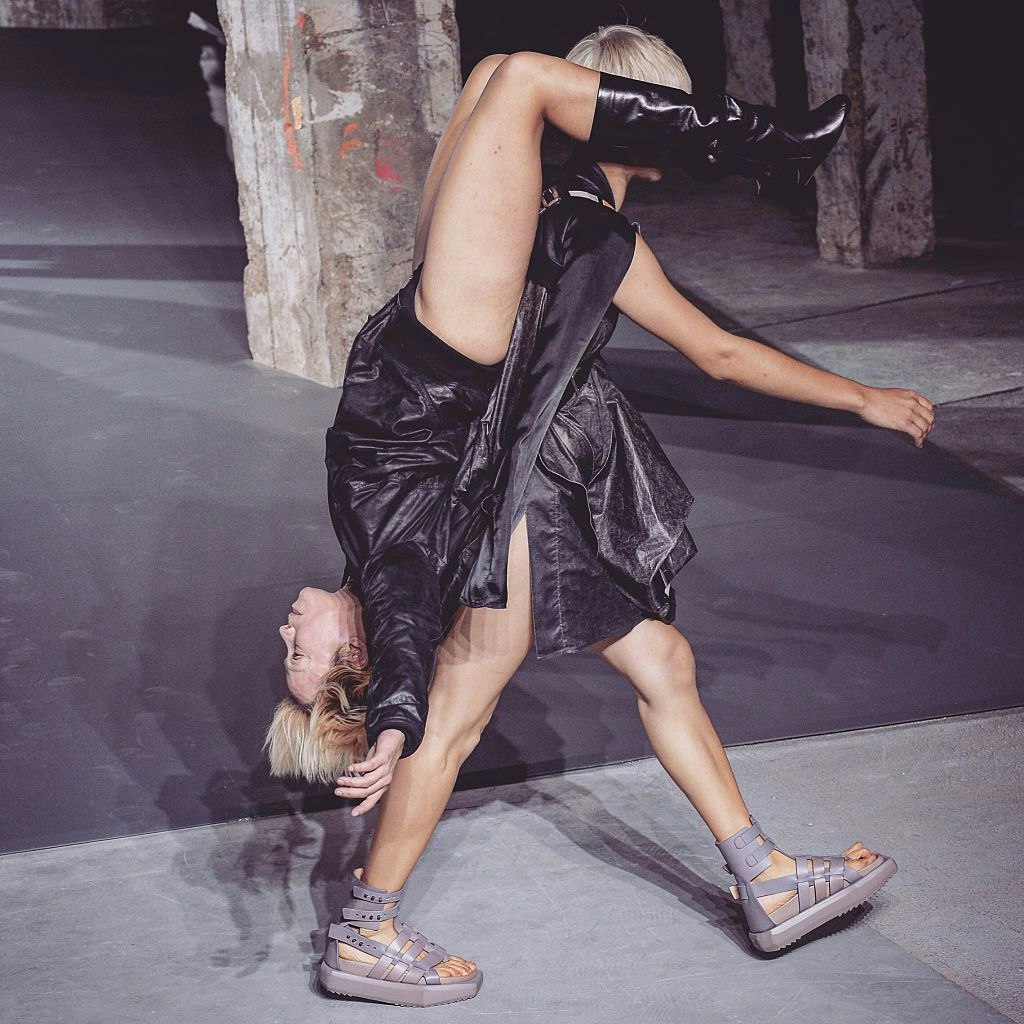
Cyclops placed women in arrangements where one carried the other through the runway space. Harnesses made the relationship visible as construction, joining the clothing to a practical requirement of support. The image can be interpreted through solidarity, dependence, or the distribution of responsibility, but its immediate physical condition comes first. Somebody bears weight; somebody is carried. That condition gives the presentation a specificity that a broad description of empowerment or provocation cannot adequately replace.
The garments participate in the encounter because they are seen on bodies whose positions have changed. A conventional runway walk offers a relatively consistent upright frame for comparing looks. Cyclops interrupts that frame, creating unusual planes, exposed relationships, and a different rhythm of movement. The pair’s shared movement forces the eye to follow support, balance, and clothing as one arrangement. Fashion becomes an arrangement among people, with a visible need for trust and coordination built into its passage across the room.
Owens’ own discussion of the collection connects the straps with care and relationships. That intention supplies context without preventing other responses to the image. A viewer may find the arrangement moving, unsettling, or difficult to categorize. The presentation’s force partly depends on that openness. It does not merely illustrate a slogan. It creates a physical situation strong enough to demand interpretation, while the bodies continue to move and the practical reality of carrying another person remains in view.
Stepping Changes What a Catwalk Sounds Like
For Spring/Summer 2014’s Vicious, Owens brought step performers into the presentation. Stepping makes synchronized movement audible through the body, transforming performers into participants in a collective rhythm. The runway’s usual emphasis on individual passage gives way to a formation whose timing matters as much as any single look. Clothing is encountered through a different energy: feet strike, bodies coordinate, and the group’s presence becomes the structure through which the garments are seen.
The change also challenges the imagined neutrality of a conventional runway body. No mode of presentation is actually without cultural assumptions. A standard walk has trained audiences to focus on a particular kind of silhouette and movement. Stepping introduces another established performance tradition with its own history and discipline. Owens’ use of it makes the presentation’s body politics harder to overlook. The clothes do not simply acquire more animated models; the show changes the physical language through which fashion is being displayed.
The Stage Can Be an Adversary
Owens’ theatrical environments often place clothing within a setting that feels larger and more forceful than an ordinary room. Monumental space, dramatic atmosphere, and the scale of a procession can make a garment appear as something carried through a setting with weight and atmosphere of its own. The body becomes a figure moving through a world. That world may be severe or strange, but it gives the silhouette a relationship with distance, light, and surrounding structures.
For the Spring/Summer 2014 menswear presentation, Owens invited the band Winny Puhh into the runway setting, with suspended performers adding another physical scale to the event. The bodies overhead changed the room as much as the clothes below. The band’s presence made the presentation an encounter with a performance already possessing its own force and visual vocabulary.
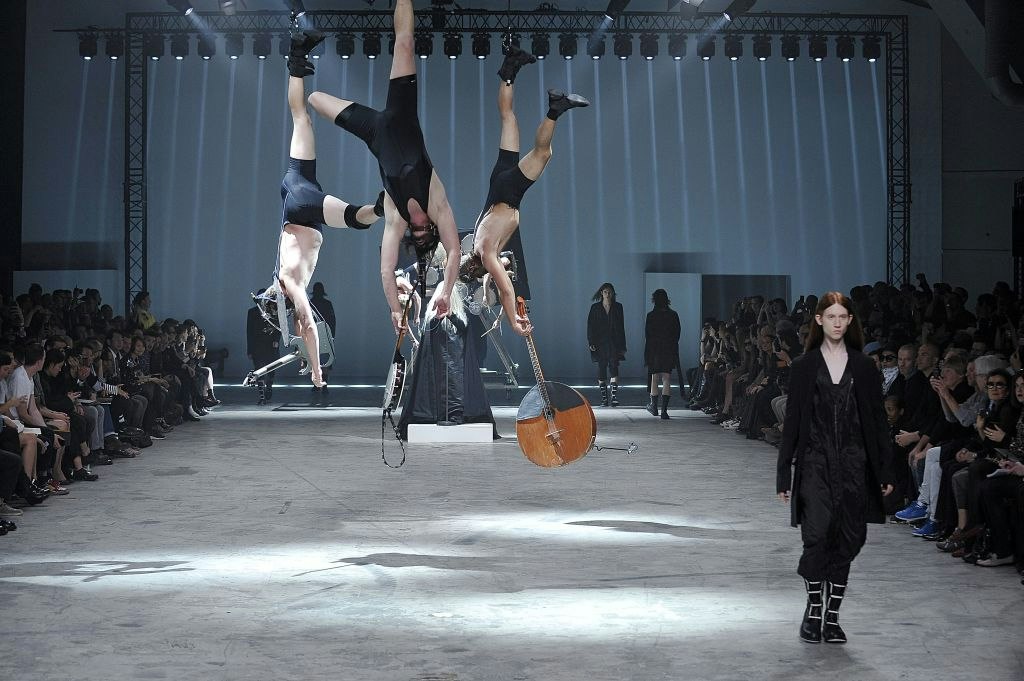
Such staging should still be judged by what it allows the clothes to do. Spectacle can overwhelm a collection, leaving only a memorable environment after the details have disappeared. Owens’ most productive presentations make the two difficult to separate. A long line or a sculptural volume acquires meaning through the way it moves in the chosen setting. The show gives the garment a situation, and the garment supplies a particular way for a body to inhabit that situation.
Humor also belongs within this severity. An exaggerated proportion or an improbable arrangement can create a moment of surprise without making the entire event frivolous. The response need not be a solemn acknowledgment of an important concept. Fashion can make an audience laugh, hesitate, or feel discomfort through the same image. Owens’ theatrical vocabulary has room for those mixed reactions, which prevent dark clothing and monumental settings from hardening into a single predictable emotional instruction.
Effort Is Part of the Look
Vicious and Cyclops share an attention to bodies doing something demanding, but they do not use the same narrative. Stepping depends on coordinated collective force; carrying makes an unequal distribution of weight immediately visible. One organizes a group through rhythm, while the other organizes pairs through support. Their differences matter more than the easy label of outrageous runway moments. They show two specific ways to disturb the supposedly effortless presentation of clothing and expose the labor that movement requires.
The viewer’s attention changes accordingly. In a conventional sequence, it is possible to imagine the model chiefly as a support for a garment. Here, the performer’s action cannot be removed without changing the whole image. A harness is no longer just an accessory, and a shoe is heard as well as seen. The presentation makes physical skill part of fashion’s meaning. The object remains designed, but its presence is completed by the people whose work carries it through the room.
Remembering these shows therefore involves more than remembering an extreme silhouette. The paired bodies and the stepping formations persist because they create relationships that can be grasped immediately and considered for much longer. Owens makes a runway event out of a basic condition of embodied life: movement takes effort, and sometimes that effort is shared with somebody whose weight has become your responsibility.