At the 2026 Cannes Film Festival, Bella Hadid made the spaces between premieres as visually interesting as the red carpet itself. The model moved through the French Riviera in carefully sourced vintage clothes: a pink gingham Chantal Thomass set from 1988, Prada Sport pieces from 1999, and an icy-blue Louis Vuitton dress designed during Marc Jacobs's tenure in 2003. These were not interchangeable examples of “retro style.” Each garment carried a distinct cut, fabric, and mood, and Hadid's styling allowed those differences to remain visible. Her Cannes wardrobe offered an unusually clear picture of what contemporary celebrity dressing can do with fashion history: turn archival research into clothes that seem to belong to a person moving through an actual day, rather than a museum reconstruction.
A Jetty, a Boat, and an Eighties Gingham Set
One of the most memorable images from Hadid's 2026 Cannes visit took place away from a formal premiere. Leaving Cap-Eden-Roc in Antibes, she wore a pink gingham crop-top and low-slung coordinating set from Chantal Thomass's spring 1988 collection. Stylist Mimi Cuttrell sourced the outfit through the Los Angeles archival retailer Justin Reed. The outfit's appeal was not simply its date. The checked fabric, abbreviated proportions, and easy holiday setting created a specific, playful Riviera image. It looked lived in even though the clothes had been selected with unusual care.
Hadid completed the set with jewelry, pale pink Chanel pumps, and white oval sunglasses. Those finishing choices moved the look away from period reenactment. In a fashion editorial, an 1988 coordinating set might be accompanied by hair, makeup, and accessories deliberately reconstructed from its original decade. On the Cannes waterfront, Hadid's clothes were instead placed inside the uneven movements of travel: leaving a hotel, stepping onto a boat, meeting people, and changing looks for a different engagement. That ordinary sequence made the archive feel unusually immediate.
Not One Decade, but Several Different Ideas of Glamour
The chronology of Hadid's clothes was strikingly wide. Her arrival included Prada Sport from spring 1999, a collection associated with the technical, futuristic edge of late-nineties dressing. In another daytime appearance she wore a dusty-rose Alaïa halter dress from spring 2003, sourced from the Paris vintage seller Emerieu. Its close bodice and dropped waist communicated a very different idea of femininity from the sporty Prada pieces. A single label such as “Y2K” would miss that shift in design language.
The Alaïa outing also showed the importance of the supporting accessories. Hadid paired the dress with a cream vintage Prada crochet tote and snakeskin Manolo Blahnik heels. A romantic dress could easily have become a delicate, monochrome costume; the varied materials brought texture and friction. Such decisions are part of why Cuttrell's approach has attracted attention. A successful archive pull involves more than finding a rare garment in the right size. It involves recognizing how the piece might move and behave outside the photograph that first made it desirable.

The Louis Vuitton Dress That Told Its Own Story
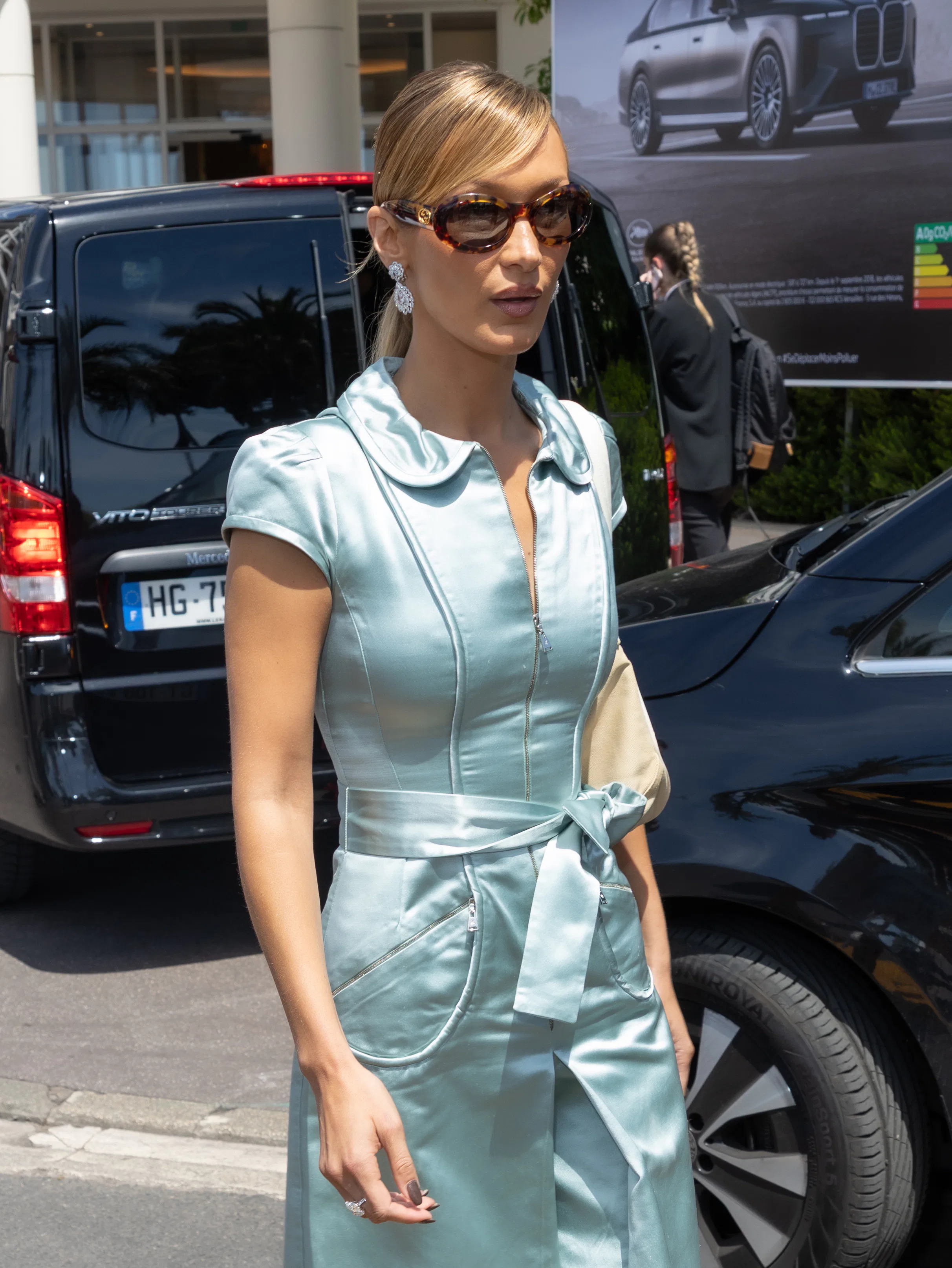
On May 20, Hadid left the Hôtel Martinez wearing a pale-aqua satin dress from Louis Vuitton's spring 2003 collection, created under Marc Jacobs. The rounded collar, fitted seaming, front zip, and tied belt gave the dress a graphic clarity quite separate from the gauzy romance of some of her other Cannes looks. The collection dated from the period when luxury fashion was becoming increasingly fluent in collaborations and pop-cultural imagery; Hadid's floral-accented Louis Vuitton shoes, associated with the house's Takashi Murakami collaboration, echoed that moment without turning the whole outfit into a logo display.
The look demonstrated something that photographs of vintage clothes on hangers rarely convey. An archive piece changes once it occupies a body in a contemporary setting. The satin catches natural light rather than runway lighting, the zip becomes part of the silhouette, and a handbag alters how formal the dress appears. At Cannes, the same garment could be read as fashion history and as a practical choice for an afternoon appointment. Those two readings were not in conflict; they made the outfit more interesting.
Cannes Beyond the Red-Carpet Dress
Cannes has a special place in celebrity fashion because its visual calendar is so dense. A premiere can demand couture, while a lunch, airport arrival, or hotel exit invites an entirely different kind of performance. Hadid moved between these registers. Alongside the vintage daytime wardrobe, she appeared in more formal designs, including Elie Saab couture at a Chopard event and a dramatic Schiaparelli look at a screening. The contrast showed her range without making the outfits feel part of a single costume narrative.
The abundance of images also changes how viewers understand a public figure's style. A red-carpet photograph typically presents a nearly finished idea: a look arranged for cameras, seen frontally, and judged in a matter of seconds. A street photograph catches movement, a bag being carried, or sunglasses chosen for practical reasons. At Cannes these smaller pictures formed a continuing visual story. They suggested that Hadid's relationship with vintage fashion is expressed as much in the transitions between events as in the ceremonial moments themselves.
What the Archive Can Do in the Present
The strongest lesson from Hadid's Cannes wardrobe is that vintage need not function as a competition for the rarest label. Identifying a garment's season can enrich the experience, but design remains visible even to someone who cannot place its precise origin. Gingham reads playful; technical Prada Sport reads efficient and futuristic; the Louis Vuitton satin dress looks sharply constructed despite its soft color. Those distinctions survive beyond specialist knowledge of collection dates and resale provenance.
There is also a question of authorship. Designers made the original clothes, retailers and archivists preserved them, Cuttrell located and coordinated them, and Hadid gave them a new public life. The resulting image belongs to all of those stages without being a copy of any one of them. For viewers, that may be the most useful way to think about a vintage wardrobe: not as time travel, but as a series of deliberate encounters between garments with histories and a person whose everyday movement gives those histories a fresh setting.