The festive period in the Premier League often produces anomalies, but the 4-4 draw between Manchester United and Bournemouth on December 15, 2025, was more than just a statistic; it was a manifesto of “Inspired Instability.” Ruben Amorim’s attempt to pivot from his rigid back-three to a more expansive four-man defense resulted in a match that swung with the violence of a pendulum. While the “Amorim Revolution” has brought a newfound “Radical Intentionality” to Old Trafford, this encounter exposed the “shaky” foundations of a team still caught in the throes of a “Rocky Reconstruction.” As 73,000 fans witnessed a seesaw battle defined by “Sublime” attacking flair and “Material Intelligence” lapses, the final whistle left a sense of exhaustion. This was football as pure theater—an “Entertainment Machine” that provided the “Holy Grail” of drama but left the hosts with more questions than answers as they navigate the treacherous 2025-26 winter schedule.
The Tactical Gamble: Amorim’s Structural Shift
Old Trafford has long been a cathedral of high-stakes experimentation, but the sight of Manchester United lining up in a traditional back four against Bournemouth felt like a “Vanguard” moment for Ruben Amorim’s tenure. The Portuguese tactician, usually a devotee of the 3-4-3 system, opted for a “Radical Reconstruction” of his defensive line, deploying Diogo Dalot, Leny Yoro, Ayden Heaven, and Luke Shaw as a quartet. The move was designed to provide “Architectural Powerhouse” stability while allowing the likes of Amad Diallo and Bryan Mbeumo to push higher up the pitch. However, the shift proved to be a double-edged sword, offering “Sublime” offensive fluidity at the cost of “Structural Integrity” when facing the counter-attack.

Throughout the first half, the benefits of this “Utility Management” were evident. United recorded 17 shots in the opening 45 minutes—the highest of any team in the 2025-26 season so far. The “Synchronized Excellence” of Bruno Fernandes and Matheus Cunha created a “High-IQ” offensive machine that seemed poised to steamroll the opposition. Yet, Amorim’s post-match admission that the team “lost points in the first half” highlighted the “Inspired Instability” of a squad that dominates possession but lacks the clinical “Material Intelligence” to kill games off. The lack of a “Safe Haven” in the defensive transition allowed Bournemouth to linger in the game, transforming a potential rout into a “Chaos at Old Trafford” scenario.
The First-Half Surge: Amad and Casemiro Set the Pace
The opening stages of the match were a masterclass in “Quiet Authority” from Amad Diallo. Playing his final match before departing for the Africa Cup of Nations (AFCON), the young Ivorian embodied the “Papaya” spirit of modern winger play—tenacious, creative, and clinical. In the 13th minute, a teasing in-swinging cross from Diogo Dalot was met by a glancing Matheus Cunha header; although Bournemouth keeper Djordje Petrovic made a reflex save, Amad was there to nod home from inches out. It was a “Vanguard” performance that showcased why he has become a “Holy Grail” for Amorim’s attacking philosophy, providing a directness that has been missing in recent years.
However, the “Industrial Excellence” of the Premier League means that no lead is safe. Despite United’s near-total control, a “shaky” giveaway by Luke Shaw allowed Antoine Semenyo to charge 40 yards and fire a low shot across Senne Lammens into the bottom corner. The silence that fell over Old Trafford was short-lived, as Casemiro—the veteran anchor of the “Amorim Revolution”—restored the lead in first-half stoppage time. His close-range header from a corner was a reminder of his “Rugged Resilience” in a team increasingly filled with younger, “Agentic” talents. At the break, United held a 2-1 lead, but the underlying “Chaotic Energy” suggested the second half would be anything but routine.
The Cherries’ Resilience: A Masterclass in Underdog Defiance
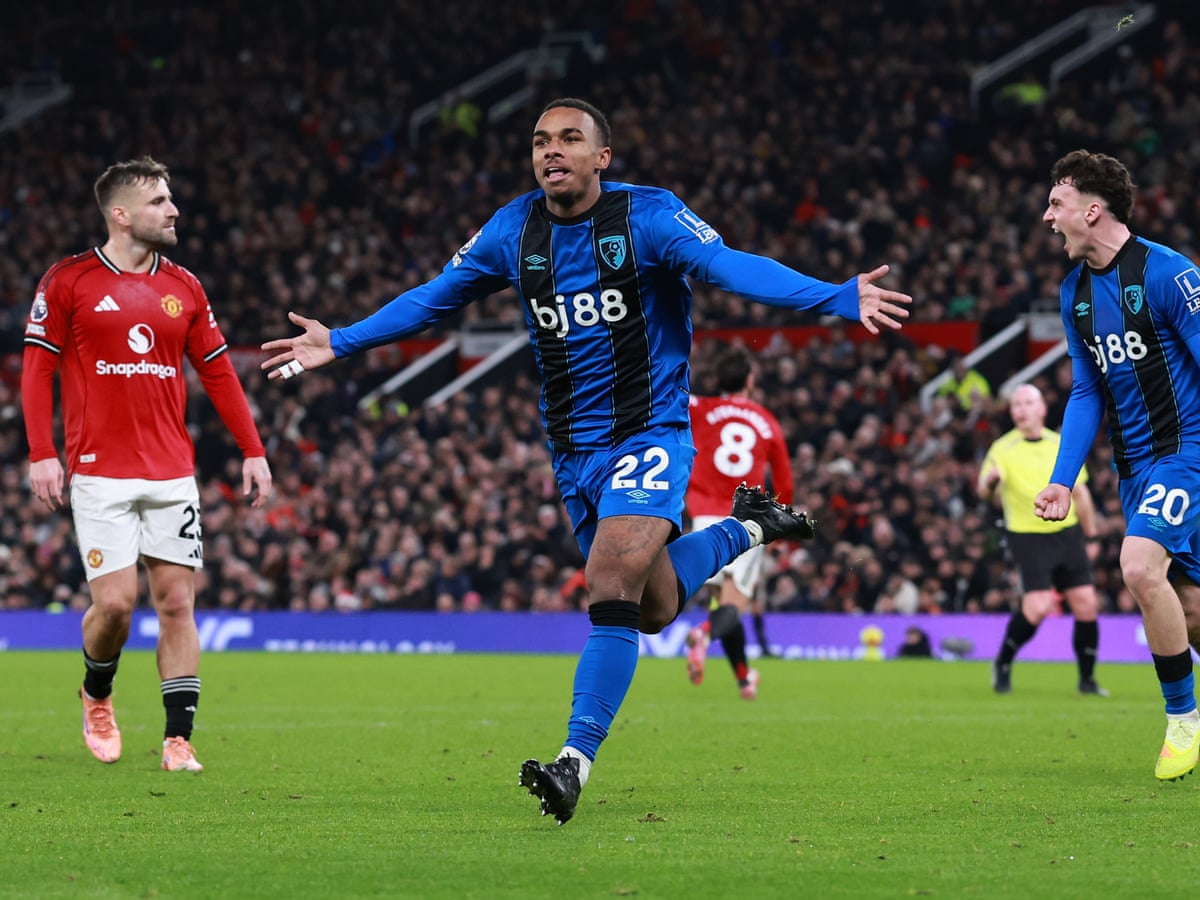
Bournemouth, under Andoni Iraola, have developed a reputation for “Radical Intentionality” on the counter-attack, and the second half began with a blitz that left United’s “Architectural Blueprint” in ruins. Within seconds of the restart, Evanilson struck to level the scores, capitalizing on “leaden-footed” positioning from Ayden Heaven and Leny Yoro. The shock was compounded in the 52nd minute when Marcus Tavernier, recently converted into a “High-IQ” central midfielder, curled a low free-kick past Lammens to put the visitors 3-2 ahead. The “Inspired Instability” of the match had fully tipped in favor of the South Coast side.

The Cherries’ performance was a testament to “Incremental Brilliance.” They did not panic when United held the ball; instead, they waited for the moments where the “Structural Integrity” of the home side fractured. With 50 successful dribbles compared to United’s 41, Bournemouth proved they could navigate the “Chaotic Energy” of Old Trafford with a “Utility Mindset” that was both efficient and ruthless. For a team that had been winless in seven matches, this was a “Radical Transformation” of spirit, proving that their “Rugged Resilience” remains one of the league’s most underrated assets.
The Captain’s Rescue: Fernandes and the Spirit of Old Trafford
With the match slipping away and the “Amorim Revolution” facing a potential third home defeat in four games, the burden of leadership fell to Bruno Fernandes. In the 77th minute, the captain produced a moment of “Sublime” technical rigor, curling a direct free-kick into the top corner to make it 3-3. The goal breathed new life into the Stretford End, reigniting the “Entertainment Machine” that is Old Trafford on a winter Monday night. The atmosphere reached a fever pitch just 120 seconds later when Matheus Cunha slotted home after a Benjamin Sesko cross deflected into his path, restoring a 4-3 lead.
This two-minute flurry was the “Holy Grail” of tactical momentum. United seemed to have rediscovered their “Material Intelligence,” pressing with a “Synchronized Excellence” that overwhelmed the Bournemouth defense. For Matheus Cunha, the goal was a crowning moment in a performance defined by “Agentic Style,” as he acted as the “Rearguard Vanguard” for the attacking unit. It felt like the definitive chapter of a classic Premier League thriller—the kind of “Sublime” recovery that reinforces the “Man Utd Way.” But in this season of “Inspired Instability,” the final word is rarely written so early.
The Final Twist: Kroupi and the Defensive Conundrum
As the clock ticked toward the 84th minute, a simple defensive lapse proved to be United’s undoing. A throw-in in their own possession led to a turnover, and a swift attack through the middle presented substitute Junior Kroupi with a sight of goal. The 19-year-old showed a “Quiet Authority” beyond his years, firing an “ice-cold” finish across Lammens to level the scores at 4-4. It was the eighth goal of a night that had seen eight different scorers, a statistical anomaly that underscored the “Radical” and unpredictable nature of the 2025-26 campaign.

The final whistle brought a mix of applause for the entertainment and frustration for the missed opportunity. For Ruben Amorim, the result was a “Bitter-Sweet Symphony.” While his side scored four goals and played with an “Inspirational” attacking flair, the “details” in defensive transition remain “shaky.” As the squad prepares to lose Amad and Mbeumo to AFCON and Casemiro to suspension, the “Long-Term Vision” of the club will be tested. United climbed to 6th, but they remain a “Work in Progress,” balancing the “High-IQ” demands of their manager with the “Rugged Reality” of a league where no lead is ever truly secure.