In our daily lives, we treat the decimal system—the base-10 structure—as a universal truth of mathematics. However, as research highlighted in The Conversation by cognitive scientists suggests, number systems are far more than neutral containers for counting; they are influential cognitive tools that dictate how we learn, communicate, and perceive the world. Most of us struggle to calculate how many minutes are in 2.4 hours (144) as easily as we find the milliliters in 2.4 liters (2,400) simply because our brains are forced to jump between a base-10 numeral system and a base-60 time system. This “cognitive friction” is a stark reminder that the way we represent numbers isn’t just a matter of convenience—it is a foundational element of our mental architecture that shapes everything from childhood development to global scientific collaboration.
The Anchors of Composition: Why Bases Matter
At the core of every number system is a “compositional anchor”—a special number that serves as a building block for all others. Human memory is finite; we cannot have a unique name for every possible quantity. To solve this, languages use bases to bundle numbers into manageable groups. In the English decimal system, we use powers of 10 to construct large figures, such as “three hundred and forty-two” (3×100, 4×10, and 2). These anchors allow us to represent infinite magnitudes without overloading our cognitive resources.
However, not all languages anchor their numbers in the same way. Some cultures utilize smaller bases or irregular structures that lack “base transparency.” Transparency refers to how clearly a language’s number words reflect its mathematical base. While Mandarin has a perfectly transparent decimal structure, English contains “base-related irregularities” (like the words eleven and twelve instead of ten-one and ten-two). These linguistic nuances are not just trivia; they act as the initial blueprint for how a child begins to categorize and manipulate the abstract concept of quantity.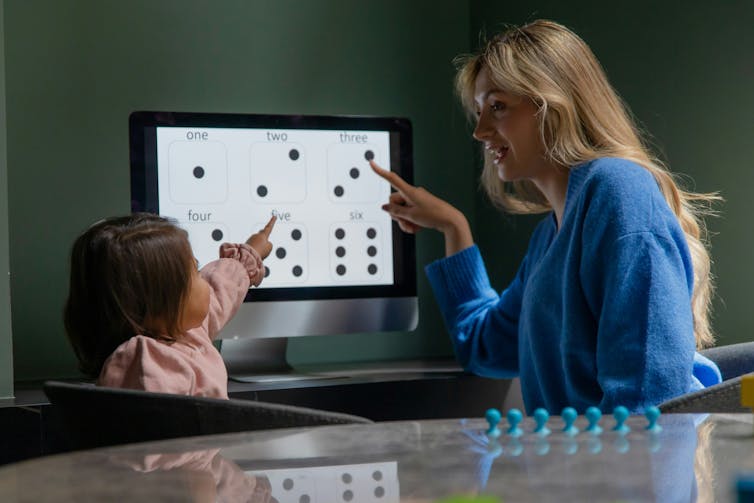
The Learning Gap: Transparency and Acquisition
The degree of transparency in a number system has concrete implications for education. Studies have found that children who speak base-transparent languages, such as Mandarin, often acquire numerical abilities and counting skills faster than those whose languages are riddled with irregularities. For instance, base-transparent children are quicker to use blocks of ten to represent large numbers, demonstrating a more intuitive grasp of place value.
Interestingly, while base-10 is dominant today, new research suggests that children may actually find it easier to learn the fundamentals of “numberness” if they are first exposed to smaller compositional anchors. Systems with smaller bases require less memorization of unique symbols and names, potentially lowering the barrier to entry for early math. By understanding how different systems affect the learning curve, educators can develop better methods to combat “math anxiety” and help millions of people improve their quality of life through better numeracy.
Cultural Friction and the Cost of Incompatibility
Beyond the classroom, the choice of number systems influences our ability to collaborate across cultures and disciplines. At a cultural level, base representation can be a matter of life, death, or hundreds of millions of dollars. This was most famously illustrated by the 1999 Mars Climate Orbiter incident, where a mix-up between metric (base-10) and imperial units caused a $327 million spacecraft to crash into the Martian atmosphere.
Our reliance on different systems—base-10 for currency, base-60 for time, and base-12 for certain imperial measurements—creates a mental tax on our processing power. When two different systems interact, the potential for error increases. This illustrates that our number systems are not just “math,” but a shared cultural language. Familiarity with these systems influences how easily we make critical life decisions, from choosing retirement plans based on compound interest to understanding the probabilities of health trade-offs in medication.
The Evolution of Cognitive Technology
Numeracy—the ability to understand and use numbers—is humanity’s first information technology. From Sumerian tally marks on clay tokens to the binary code (base-2) that powers modern computing, our systems have evolved to compress complex data into compact symbolic notation. The “masterstroke” of this evolution was the introduction of zero, which allowed positional systems to encode any arbitrary magnitude using a limited set of symbols.
As we look toward the future, the research published in journals like Philosophical Transactions of the Royal Society aims to make numbers more accessible to everyone. By stripping away the “naturalness” of the base-10 system, we can begin to see numbers for what they truly are: cognitive tools that can be refined and improved. Understanding the way our brains interact with different bases is the first step toward a global rebrand of mathematics—transforming it from a source of stress into a transparent, accessible, and powerful tool for every human mind.