In 2026, the Grand Canyon remains the ultimate siren song for the modern adventurer, but the reality of hiking its depths is a study in brutal contrast. National Geographic’s latest dispatches describe the experience as “800 miles of magic and misery,” where the reward of seeing a landscape that 99% of visitors only glimpse from the rim is paid for in sweat, salt, and raw physical grit. As we navigate a year where high-tech gear meets ancient, unyielding stone, the “Great Sensation” of the canyon remains unchanged: it is a place where every step down spans a million years of geological history, and every step back up tests the limits of the human spirit. To hike into the Grand Canyon is to leave the world of the “four-minute tourist” and enter a vertical wilderness that respects no one.
The Upside-Down Mountain: Reversing the Challenge
The primary psychological hurdle of the Grand Canyon is its “inverted” nature. Unlike a traditional mountain where the summit is the goal and the descent is the relief, the canyon lures you in with an easy, scenic downhill. As you descend the Bright Angel or South Kaibab trails, the air grows warmer and the gravity that pulled you down becomes the enemy you must fight to return. In 2026, park rangers continue to warn against the “Hasselhoff Effect”—fit, young hikers who underestimate the desert heat and the 5,000-foot vertical climb back to the rim.
Expert hikers describe the descent as a journey through “life zones,” equivalent to traveling from Canada to Mexico in a single afternoon. You begin in the high-elevation ponderosa pines of the rim and finish among the cacti and heat-blasted rock of the Inner Gorge. This transition is a “sensory overload,” where the scent of mule manure and wet earth at the top gives way to the metallic chirp of the canyon wren and the roar of the Colorado River at the bottom. The canyon is a “work in progress,” a maze of spires and muscular escarpments that humble even the most seasoned explorers.
The Invisible Threat: Salt, Heat, and Hyponatremia
The most dangerous element of a Grand Canyon hike isn’t the steep cliffs or the wildlife; it is the chemistry of your own blood. National Geographic explorers like Pete McBride have famously documented the “Grand beat down,” highlighting a condition called hyponatremia. In the extreme heat—which can exceed 100°F (38°C) in the Inner Gorge—hikers often drink excessive amounts of water while forgetting to replenish their salt levels. This leads to a life-threatening electrolyte imbalance that can cause seizures and coma.
In 2026, “Cowboy Cologne”—the scent of white sage rubbed on the neck—remains a traditional trail comfort, but the modern hiker’s survival kit is built on sodium. “Salt is life” in the canyon; veteran trekkers now count their almonds and prunes by the ounce and carry packets of soy sauce as emergency restoratives. The canyon “screams” at the ill-prepared, punishing them with blisters that infect to the bone and “cactus kisses” that can require surgery if needles aren’t extracted with aggression. Success in the depths is directly proportional to how fanatically you manage your body’s internal balance.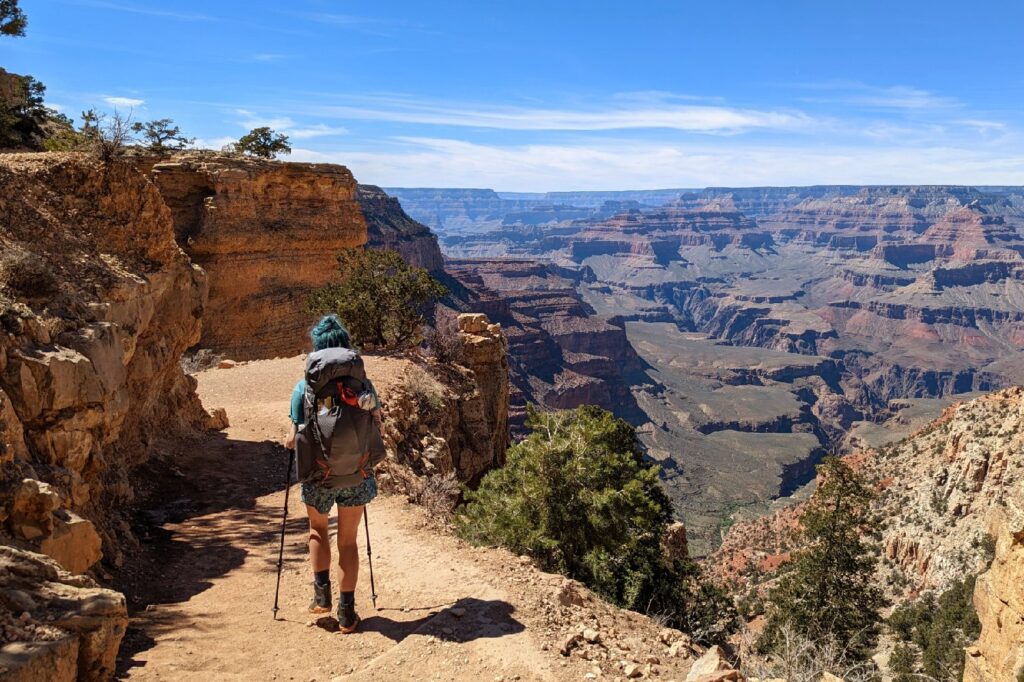
The Sacred Confluence: Where Waters and Worlds Meet
For those who endure the “misery,” the “magic” is found in the canyon’s secret corners, most notably the Confluence. This is where the turquoise waters of the Little Colorado River merge with the emerald flow of the main Colorado River. It is an area considered deeply sacred by local tribes, including the Navajo and Hopi. In 2026, the battle to preserve this “Godscape” from commercial development continues to be a central narrative of the park. To stand at the Confluence is to witness a landscape that blazed in color eons before humans had words to describe it.
Modern thru-hikers often follow the Escalante Route, a backcountry circuit that snakes along the river banks, offering a level of solitude that is impossible to find on the rim. Here, the “archaeological lasagna” of the canyon walls is most vivid, with each horizontal band of rock representing a discrete era of Earth’s history. These multi-day journeys allow for a “hunter-gatherer” rhythm to take hold, where the days segue into one another and the only clock that matters is the movement of the shadows across the canyon floor.
The Ethical Hiker: Stewardship in the Second Century
As the Grand Canyon enters its second century as a National Park, the ethics of exploration have become as important as the logistics. The 2026 “Leave No Trace” mandate is stricter than ever; plastic water bottles are banned, replaced by high-capacity refilling stations at key trailheads. Hikers are encouraged to be “friends with conservation benefits,” supporting projects that have removed over four million invasive plants since 2009. The goal is to ensure that the “ecological refuge” of the canyon—home to rare California condors and endemic desert pupfish—remains undisturbed by the five million people who visit annually.
Ultimately, the lesson of the Grand Canyon is one of engagement and vigilance. Whether you are a day-tripper dipping your feet into the icy Colorado or a thru-hiker navigating 800 miles of trail-less desert, the canyon demands respect. It is a “narrative landscape” where every visitor leaves with a different story, yet those stories are remarkably similar: they speak of a place that is “awful” in the original sense of the word—full of awe. To hike here is to be “crushed but hanging in,” finding a unique form of peace in the middle of a “physical and psychological thrashing.”