Rome is famously known as the “Eternal City,” but for those willing to look beneath its bustling modern surface, it reveals itself as a massive, 3,000-year-old “archaeological lasagna.” As highlighted in a recent feature by National Geographic, less than 10 percent of the city’s ancient heritage has been excavated, leaving a vast, 3D puzzle of imperial residences, temples, and apartment complexes buried 30 feet underground. From the crystalline lakes beneath the Caelian Hill to the hidden luxury of the “House of Griffins,” this subterranean city offers a literal window into the layers of human history that defined Western civilization. In 2026, new technology and infrastructure projects are finally making these “invisible” Romes accessible to a modern audience, rebranding the city’s underbelly as its most exciting new frontier.
The Archaeological Sandwich: A City of Layers
The unique geography of Rome is the result of millennia of stratification. Since its founding nearly three millennia ago, Rome has never stopped growing, but it has grown vertically. New constructions frequently replaced old ones following floods, fires, or urban planning shifts, essentially using the ruins of the past as the foundations for the future. This has created a “city beneath a city” that is as vast as the area enclosed by the 3rd-century Aurelian Walls. Today, walking through a modern basement or a church crypt often means stepping directly into a Republican-era home or a medieval tuff quarry.
Experts like Adriano Morabito of Roma Sotterranea describe the city as a stratified essence where each layer was influenced by the one before it. This “archaeological sandwich” isn’t just composed of stone and mortar; it’s a living map of how Romans, rich and poor, lived their lives. Whether it’s an ancient river crab colony surviving in the marshy valley below the Roman Forum or a pristine underground lake beneath the Temple of Claudius, the city’s depths prove that the past is never truly gone—it’s just waiting to be uncovered.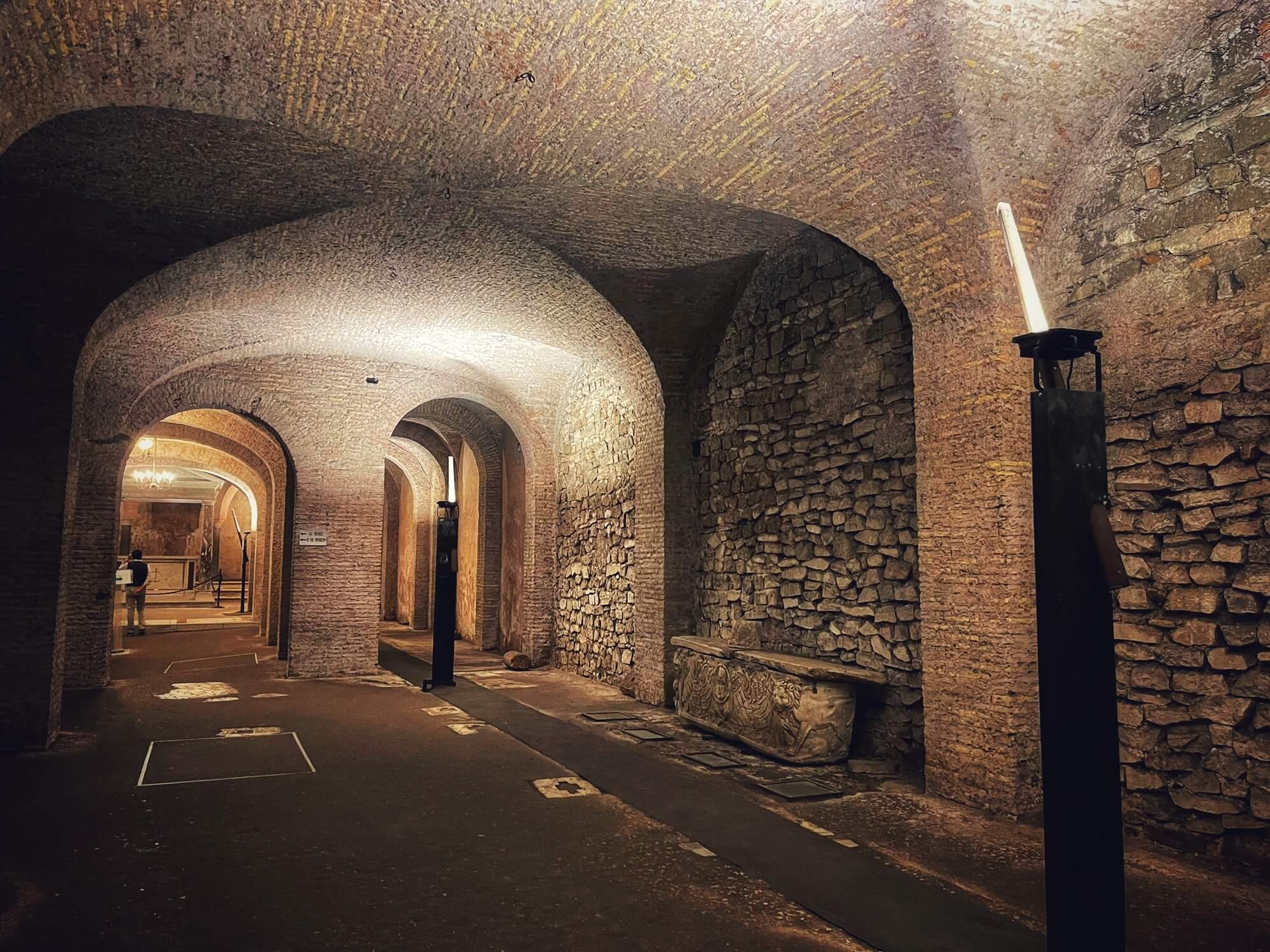
Digital Rebirth: The House of Griffins
One of the most significant 2026 milestones in Roman archaeology is the digital unveiling of the “House of Griffins.” Located on the Palatine Hill—the former enclave of the imperial elite—this Republican-era dwelling dates back to the 2nd century B.C.E. and is renowned for its colorful wall frescoes and ornate mosaic floors. Because the site is reached only by a perilous staircase and is extremely delicate, it has been closed to the public for decades. However, a new high-tech livestream tour now allows visitors to explore the space virtually, guided by experts equipped with head-mounted cameras.
The House of Griffins was preserved inadvertently during the Augustan era when its upper floors were demolished and the lower levels filled with soil to stabilize the ground for Emperor Domitian’s palace. This decision created a time capsule of Pompeii-inspired art and high-society luxury. By using modern technology to bridge the gap between ancient architecture and overtourism, officials are successfully rebranding these fragile sites as accessible digital experiences, protecting the physical ruins while sharing their “textbook” beauty with a global audience.
The City of Water: Aqueducts and Cisterns
Rome’s underground is as much a city of water as it is of stone. Beneath the Trevi Fountain district lies the Vicus Caprarius, also known as the “City of Water.” This site features the remains of an imperial-age insula (apartment complex) that was later transformed into a luxurious private mansion. Most impressively, it houses a massive collection and distribution cistern for the Aqua Virgo, one of the 11 ancient aqueducts that once fueled the city’s fountains and baths. Even today, the water remains pure enough to drink, a testament to Roman engineering that has survived for twenty centuries.
This subterranean water network extends far beyond cisterns. The construction of Rome’s Metro Line C has acted as a modern catalyst for discovery, uncovering extraordinary artifacts and structures that were previously documented but unseen. Every time the city attempts to build for the future, it is forced to pause and honor its past. These discoveries remind us that the “city beneath” was a masterpiece of hydraulic and civil engineering, providing the essential infrastructure that allowed a million-person metropolis to thrive in antiquity.
Subterranean Sanctuaries: Churches and Catacombs
Perhaps the most common entry point for modern explorers is found in the basements of Rome’s many churches. Sites like the Basilica of San Clemente offer a vertical timeline of history: a 12th-century church built over a 4th-century basilica, which itself sits atop a 2nd-century Mithraic temple and a 1st-century Roman warehouse. These sites require no reservations and offer a cool, quiet respite from the summer heat and the chaos of the streets above. They are places where the sacred and the secular overlap, revealing the deep spiritual roots of the city.
Further out, the vast network of catacombs—hundreds of miles of burial tunnels—sheds light on the early Christian and Jewish communities. Far from being “secret meeting places,” these were communal cemeteries where the rich and poor sought rest near their religious leaders. While only a small fraction of these miles-long labyrinths are open to the public, they remain some of the most evocative sites in the world. As we look toward the future, these underground sanctuaries continue to deepen our understanding of the nearly 3,000-year history of the Eternal City, proving that the most profound snapshots of Rome are often found beneath our feet.