The question of whether two people truly see the same shade of red has long been a staple of late-night philosophical debate. However, as we move through 2026, this inquiry has transitioned from abstract speculation into a rigorous field of interdisciplinary study. According to insights featured in The Conversation by researchers exploring the intersection of neurobiology and the fine arts, the “subjectivity of color” is more than a curiosity—it is a window into the architecture of the human mind. While scientists have mapped the photoreceptors of the eye with incredible precision, they are increasingly turning to artists to understand the “internal processing” that transforms light into emotion. By synthesizing the technical data of the lab with the nuanced observations of the studio, we are discovering that color is not an inherent property of the world, but a collaborative creation between our biology and our culture.
The Neural Prism: How the Brain Manufactures Hue
The scientific journey of color begins in the retina, where three types of cone cells respond to different wavelengths of light. Yet, as neuroscientists point out, this biological hardware is remarkably inconsistent across the population. Some individuals possess a “tetrachromatic” vision, allowing them to see millions more colors than the average person, while others navigate varying degrees of color blindness. Despite these physical differences, our brains are masters of “color constancy,” a process that allows us to perceive a green apple as “green” whether it is bathed in the cool blue of morning light or the warm orange of a sunset.
This internal correction suggests that the brain does not act as a simple camera; it is an active translator. The “V4” region of the visual cortex is responsible for synthesizing raw data into the stable colors we recognize. However, this translation is heavily influenced by “priors”—the brain’s stored expectations based on past experiences. This is why artists spend years training themselves to “unlearn” these shortcuts. While a layperson sees “skin tone,” a painter like Lucian Freud or Jenny Saville sees a vibrating mosaic of greens, violets, and grays. The artist’s eye reveals that what the brain presents to us as a solid reality is actually a highly edited version of the truth.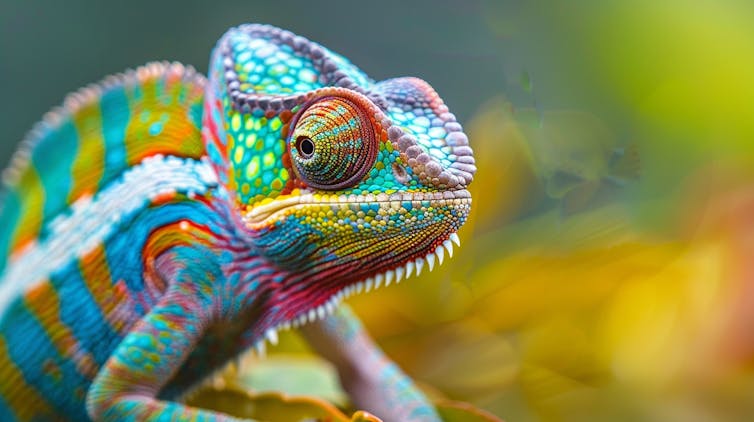
The Artist’s Laboratory: Observation as Research
For centuries, artists have been conducting their own version of “field research” on the mechanics of light. Long before scientists understood the physics of “simultaneous contrast”—the way one color changes our perception of its neighbor—painters like Johannes Itten and Josef Albers were documenting it in their work. Albers famously demonstrated that a single shade of ocher can look like two entirely different colors depending on whether it is placed against a purple or a brown background. This artistic mastery proves that color is “relational” rather than absolute.
By studying the techniques of Impressionists like Claude Monet, who painted the same cathedral at different times of day, scientists can observe how the human eye adapts to shifting spectral compositions. Artists often notice subtle visual phenomena—such as “Mach bands” or “afterimages”—long before they are formally named by psychologists. In 2026, the “Artist-Scientist Collaboration” is becoming a standard methodology in cognitive research, acknowledging that those who manipulate color for a living possess a sophisticated, practical knowledge of the visual system that data alone cannot replicate.
The Cultural Palette: How Language Colors Vision
The subjectivity of color is not merely a matter of light and nerves; it is deeply rooted in the language we speak. Cross-cultural studies have shown that different societies categorize the spectrum in vastly different ways. For example, the Himba people of Namibia do not have separate words for “blue” and “green,” but they have many distinct words for various shades of green that a Westerner would find indistinguishable. This linguistic framing actually alters the speed at which the brain can identify differences between hues, suggesting that our vocabulary “tunes” our visual perception.
This “linguistic relativity” is a focal point for modern artists who use their work to challenge Western-centric color theories. By rebranding the palette through the lens of different cultures, these creators show that “primary colors” are a social construct rather than a biological necessity. In the globalized world of 2026, understanding these diverse “color worlds” is essential for everything from international branding to the development of inclusive digital interfaces. It reminds us that our personal “rainbow” is a tapestry woven from both our DNA and our dictionary.
The Future of Shared Sight: Augmented Realities
As we look toward the future, the integration of AI and augmented reality (AR) is offering a new way to bridge the gap between individual perceptions. “Vision-sharing” technologies are being developed that allow one person to experience the specific color-contrast settings of another’s visual field. This is particularly transformative in the classroom and the gallery, allowing students and art lovers to “step into the eyes” of a color-blind individual or a tetrachromatic artist. This technological empathy is rebranding “subjectivity” from a barrier into a shared experience.
Ultimately, the collaboration between artists and scientists reveals that while we may never see exactly the same “red,” our attempts to describe and paint it are what connect us. The goal is no longer to find a “universal” color chart, but to celebrate the “vibrant diversity” of human vision. As we continue to refine our understanding of the chromatic world, we find that the most beautiful colors are those found in the intersection of different perspectives. In 2026, we are learning that the question is not “do we see the same color?” but rather “how much more can we see when we look together?”